
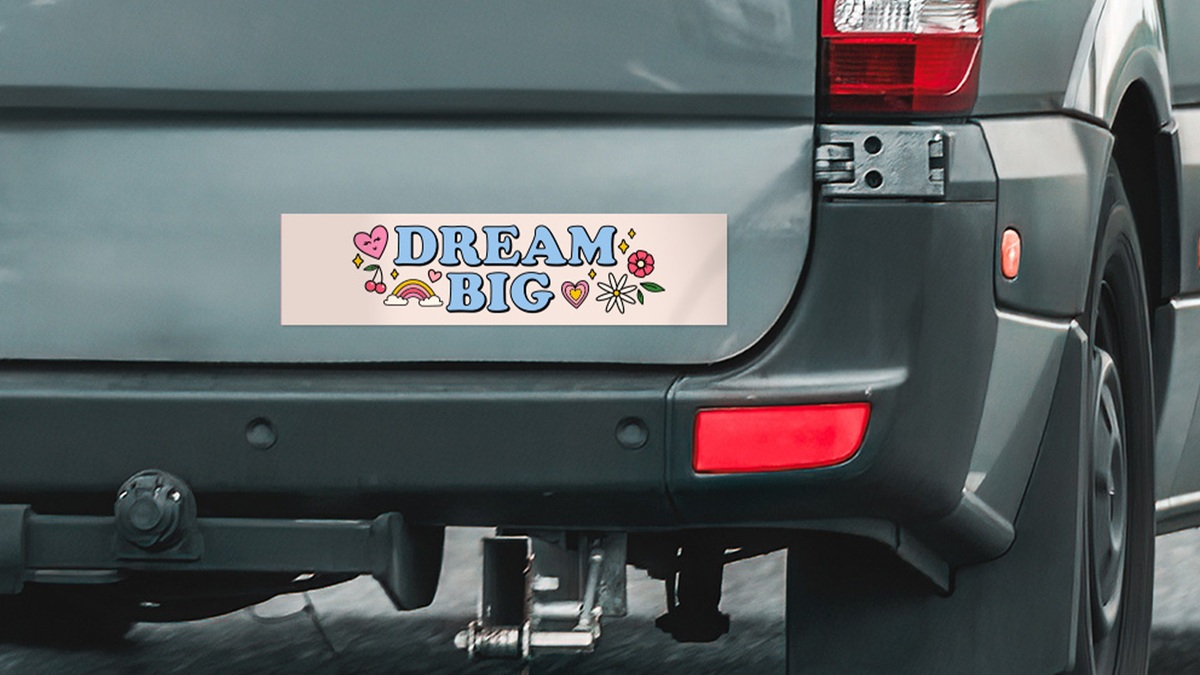
Before you could peel and stick a message to your car, you could tie one on. Early bumper signs were made of cardboard and fastened with twine or wire. The modern bumper sticker took shape in the late 1940s, and Kansas City screen printer Forest P. Gill usually gets the credit. Roadside attractions put the idea to work, and political campaigns soon followed.
How Bumper Stickers Got Their Start
People had been putting ads on moving vehicles since the days of horse-drawn carriages. Even the nets that kept flies off horses could carry a business name. Early motorists had another spot to work with. A cardboard sign tied to the rear bumper gave drivers behind them something to read, and a coat of wax or varnish helped protect the cardboard outdoors.
By 1935, Ray Stanton Avery was making self-adhesive labels for a different job. His early labels were round price stickers. Gill paired self-adhesive paper with fluorescent ink that stood out in daylight. The driver could peel away the backing and press the message onto the bumper. Printers and advertisers called these early stickers “bumper strips.”
How Bumper Stickers Hit the Road
Some of Gill’s early customers were tourist attractions, including Seven Falls near Colorado Springs. At Luray Caverns in Virginia, attendants put stickers on cars in the parking lot while visitors toured the caves. For the attraction, each departing car was a chance to get its name in front of people a roadside sign might never reach. For a visitor, the sticker could be a souvenir that traveled home in plain sight.
By the 1952 presidential race between Dwight D. Eisenhower and Adlai Stevenson, bumper stickers had found a place in national campaigning. “I Like Ike” fit the format beautifully. Three short words told the driver behind you who had your vote. Four years later, “Delaware for Ike 1956” used the same nickname to put a local spin on the national campaign.
How Printing Evolved From Paper to Vinyl
Early bumper stickers were commonly screen printed on paper. Think block lettering, a dark background, and a shot of fluorescent orange or yellow. Vinyl stood up to weather better than paper. It became common in the mid-1960s, and by the mid-1970s most screen-printed bumper stickers were vinyl. Screen printing continued on vinyl, and printers also used flexography, which uses flexible plates to print quickly on rolls of material.
In the late 1990s and early 2000s, digital printing was becoming widely available for short runs. Digital inkjet made it practical for small shops to print full-color photos and illustrations. A hiking club could put a photo of its favorite trail on a sticker, and a local business could print the same full-color logo it used on its storefront.
Bumper Stickers Today
That little strip of space still works for a lot of the same reasons. A sticker can tell people where you spent your vacation, give a local cause a name people can remember, or make the driver behind you laugh. “Student Driver” puts the most useful information right up front. A fundraiser sticker can do the same with the name of the cause and a few words about what it supports.
If you’re making one of your own, try reading your design from a few steps away. See which words you notice first. Give your main message the largest type and enough contrast to stand out. Think about what you’d remember if you only had a moment to look.


